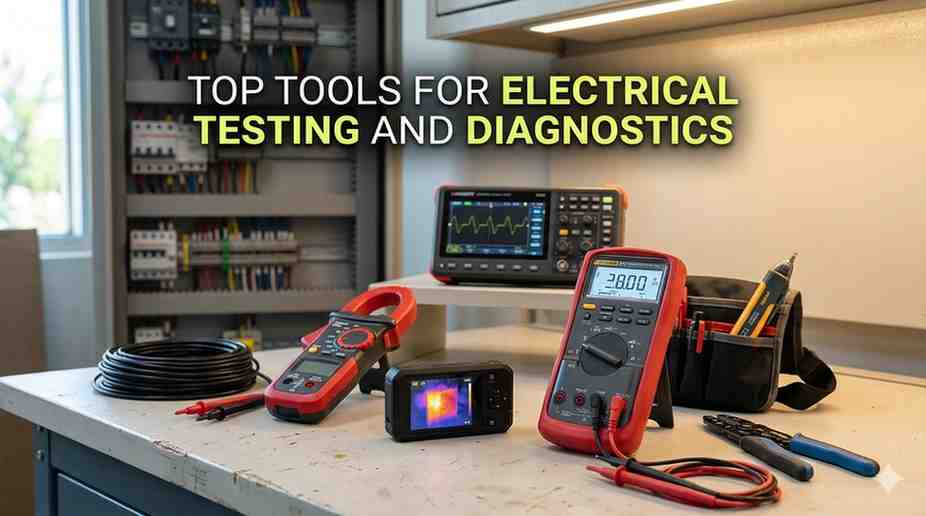
If safe, compliant, and efficient electrical work is to be successfully completed across homes, commercial premises, and industrial sites, it is essential for electrical testing and diagnostics to be carried out.
You might be reading this article as a qualified electrician, maintenance engineer, facilities manager, or even a serious DIY enthusiast with an interest in determining what test equipment you will require.
Having the right electrical testing and diagnostics tools will put you in a strong position to identify faults quickly, verify installations, and minimise downtime.
In this article, then, we’ve picked out some of the most important such test equipment. This list encompasses devices that will also help you comply with regulations and standards like BS 7671 (the IET Wiring Regulations) in the UK.
- Digital Multimeters (DMMs)
The versatility of this tool for troubleshooting faults should make it unsurprising that it is one of the most widely used instruments for electrical diagnostics. DMMs can be counted on to measure voltage, current, resistance, and continuity.
Electricians today are advised to choose true Root Mean Square (RMS) multimeters. These tools accurately measure the effective RMS value of AC voltage or current, even when the waveform is distorted or non-sinusoidal.
- Insulation Resistance Testers
In the UK, insulation resistance testing is crucial for such purposes as Electrical Installation Condition Reports (EICRs), the initial verification of installations, and preventative maintenance programmes. A failing insulation test can draw attention to issues before they have a chance to deteriorate into serious faults or fire risks.
Insulation resistance testers, then – also often referred to as “megohmmeters” or “Meggers” – are important for assessing the integrity of cable insulation. These tools apply a high DC voltage to wiring systems and measure leakage current. Poor insulation can be a telltale sign of cable damage, moisture ingress, ageing, or contamination.
- Clamp Meters
This handheld electrical test tool combines a basic digital multimeter and a current sensor. With its characteristic hinged jaws to detect the electromagnetic field around a conductor, a clamp meter gives its users a safe way to measure high-level electrical current (AC, DC, or both) without any need to cut wires or break the circuit.
These trusted instruments, then, lend themselves well to live testing and rapid diagnostics. They suit such applications as load monitoring, motor diagnostics, HVAC servicing, and detecting current imbalance.
- Socket Testers
Also called an “outlet tester”, a socket tester is a small, handheld, plug-in device that can be used to instantly verify wall sockets have been wired correctly and safely.
This first-line check is crucial to undertake before appliances are plugged into the sockets. Displaying a pattern of lights or a digital reading, socket testers detect common faults like missing earth, reversed live/neutral wires, and open circuits.
Socket testers can be convenient for such potential users as landlords, maintenance personnel, and domestic electricians. However, the use of these devices should not be treated as a direct alternative to full inspection and testing procedures in situations where these specialised processes are required.
- Residual Current Device (RCD) Testers
Residual Current Devices are critical safety components in electrical installations. An RCD is designed to instantly break a circuit when it detects electricity leaking to earth, thereby helping to prevent fatal electric shock and reducing fire risks.
Also sometimes referred to as “tripping time testers” or “RCD checkers”, RCD testers are specialised instruments with the purpose of verifying the proper operation and safety of RCDs. They confirm that protective devices trip correctly under fault conditions.
RCD testers measure such parameters as trip time, trip current, and touch voltage. Accurate RCD testing is particularly important during EICRs and new installation certification.
Well-Chosen Test Equipment Plays an Imperative Role in the 2020s
When it comes to maintaining the highest standards of safety, compliance, and efficiency across modern electrical systems, the importance of selecting the right tools for the job can’t be underestimated or overlooked.
The correct use of instruments like those we have outlined in this article allows for faster troubleshooting and the more accurate detection of faults.
In an era like the present one, characterised by increasingly complex electrical systems, it has never been a more urgent priority to invest in appropriate and high-quality test equipment. Doing so goes a long way to ensuring vital infrastructure is safe, dependable, and will deliver the necessary and expected performance.