Storing and Handling Retatrutide: A Practical Guide for the Laboratory
Few laboratory compounds have attracted as much attention in such a short time as retatrutide. Yet for all the discussion of trial results and receptor biology, one practical subject gets surprisingly little coverage: how the compound should actually be stored and handled once it arrives in the lab. Peptides are fragile molecules, and poor handling can quietly ruin an experiment long before any data is collected.
Why peptides need special care
Retatrutide is a chain of 39 amino acids with a fatty acid side chain attached. Like most research peptides, it is supplied as a lyophilised, or freeze-dried, powder. Freeze-drying removes water so the molecule is held in a stable, solid state. In that form, a well-made peptide can remain intact for a long time.
The risks start when that stability is disturbed. Heat, light, moisture and repeated temperature swings can all break down a peptide chain or cause the molecules to clump together, a process called aggregation. Neither is visible to the naked eye. A degraded vial looks exactly like a good one, which is why careful handling matters as much as buying from a reliable source in the first place.
Storing the powder
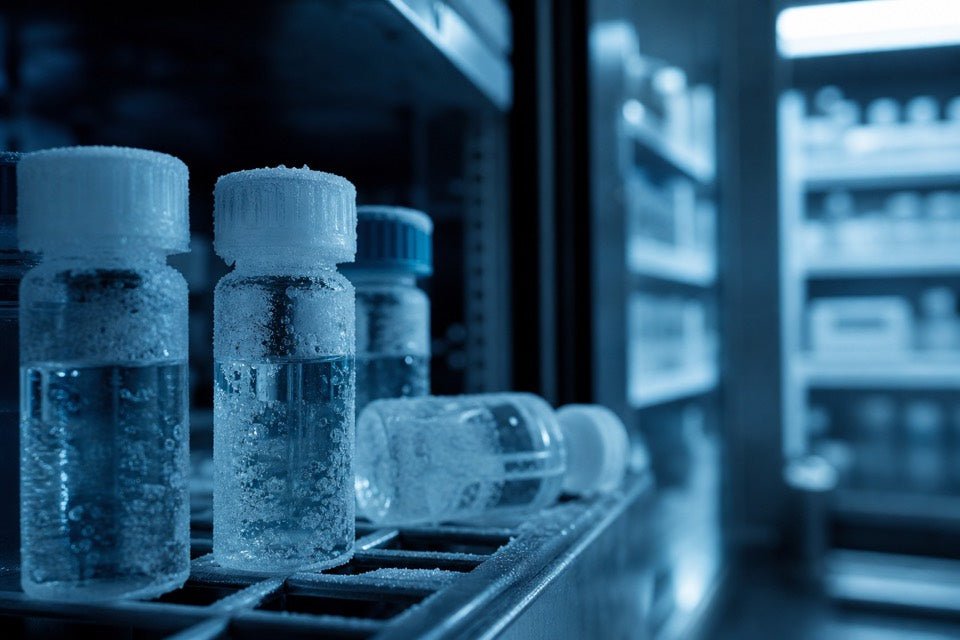
For unopened vials of lyophilised peptide, most laboratories follow a simple rule: keep them cold, dark and dry. Refrigeration at 2 to 8 degrees Celsius is standard for short-term storage, while longer-term storage is usually at minus 20 degrees. Vials should stay sealed in their original packaging until needed, away from direct light.
Condensation is an easily overlooked risk. Taking a cold vial straight out of the freezer and opening it in a warm room lets moisture from the air settle on the powder. Good practice is to let the vial reach room temperature before the seal is broken.
Reconstitution basics
Before a lyophilised peptide can be used in most assays, it must be dissolved, or reconstituted. Bacteriostatic water, which is sterile water containing 0.9% benzyl alcohol, is a common choice because the preservative helps limit microbial growth once the vial has been opened.
Technique matters here. The liquid should be added slowly, run down the inside wall of the vial rather than sprayed directly onto the powder. The vial is then swirled gently or allowed to sit until the powder dissolves. Shaking is avoided because it can introduce air bubbles and physical stress that encourage aggregation. A properly reconstituted solution should be clear; cloudiness or visible particles are a warning sign.
Getting the concentration right is equally important. The amount of liquid added determines how much peptide is present in each unit of volume, and simple arithmetic errors at this stage can throw off an entire set of results. Many researchers now use a peptide reconstitution calculator to check their figures before they begin.
After reconstitution
Once dissolved, a peptide becomes far less stable than it was as a powder. Reconstituted solutions are generally kept refrigerated and used within a limited window, often a few weeks, depending on the compound and the solvent. They should never be frozen and thawed repeatedly. If a solution is needed over a longer period, laboratories often split it into small single-use portions, called aliquots, so the main stock is not repeatedly exposed to temperature changes.
Labelling is part of good handling too. Each vial should record the compound, the concentration, the date of reconstitution and the batch number. That makes it possible to trace any unexpected result back to its source.
Starting with quality material
None of these steps can rescue a poor product. If a vial contains the wrong amount of peptide, or impurities from careless synthesis, even perfect handling will produce unreliable data. That is why researchers look for suppliers who provide batch-specific certificates of analysis from independent laboratories, showing purity by HPLC and identity by mass spectrometry.
UK supplier Revial Labs publishes third-party test results for its research-grade retatrutide, allowing laboratories to match the certificate to the batch they receive. For a broader overview of the compound and its status in the UK, this retatrutide UK guide explains the science and the regulatory position in plain language.
A small checklist
Pulling it together, a careful lab workflow for retatrutide looks something like this. Store sealed vials cold, dark and dry. Let them reach room temperature before opening. Reconstitute slowly with sterile bacteriostatic water and swirl rather than shake. Double-check concentration calculations. Keep the solution refrigerated, avoid freeze-thaw cycles and divide it into aliquots where needed. Label everything, and keep the certificate of analysis on file.
It is not glamorous work, but it is the foundation of reproducible research. In a field moving as quickly as metabolic peptide science, the labs that get the basics right are the ones whose results can be trusted.
Retatrutide is an investigational compound that has not been approved by the MHRA or any other regulator. Research-grade material is supplied strictly for in vitro laboratory use and is not for human or veterinary use.