Hair loss is often discussed as a male concern, but the reality is that millions of women around the world experience significant hair thinning and loss. Female hair loss can be just as distressing, if not more so, due to its social and emotional significance. The good news is that hair transplants for women are an increasingly effective and natural-looking solution for women who meet the right criteria.
Can Women Get a Hair Transplant?
Yes women can absolutely get a hair transplant, and the results can be just as natural and long-lasting as those achieved in men. However, female hair transplants require careful assessment and a slightly different approach than male procedures. Not every woman experiencing hair loss is an ideal candidate, which is why a thorough consultation is essential before proceeding.
| Key Point | A good candidate for female hair transplant has a stable donor area typically the back and sides of the scalp from which healthy follicles can be harvested and relocated. |
What Causes Hair Thinning in Women?
Unlike male pattern baldness, which tends to follow a predictable hairline recession, female hair loss is more varied in its presentation. Understanding the underlying cause is the first step in determining whether a hair transplant is the right solution.
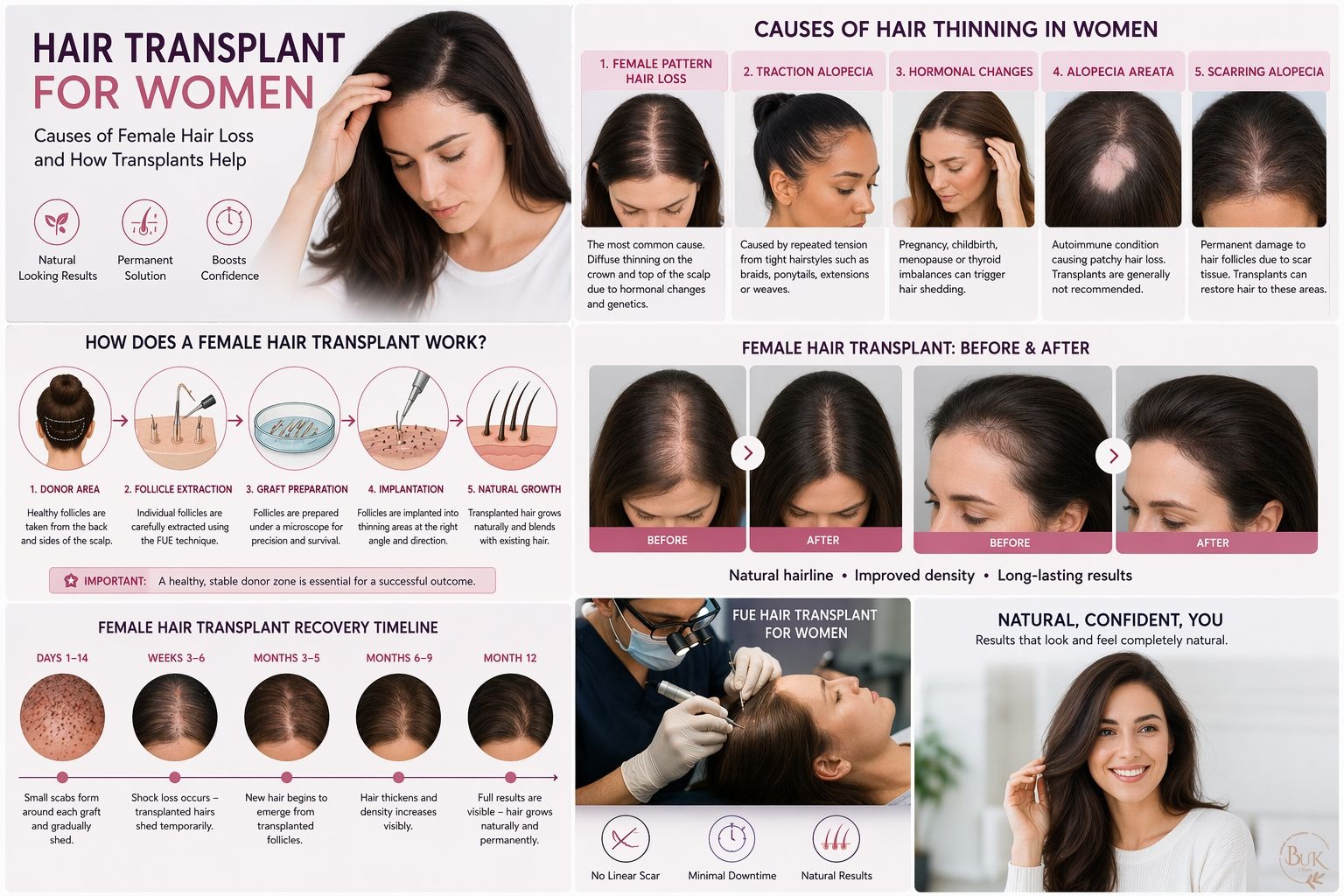
1. Female Pattern Hair Loss (Androgenetic Alopecia)
The most common cause of female hair loss, affecting an estimated 40% of women by the age of 50. It is characterised by diffuse thinning across the crown and top of the scalp, while the hairline itself usually remains intact. It is linked to hormonal sensitivity to androgens (male hormones that women also produce at lower levels).
2. Traction Alopecia
Caused by repeated tension on the hair follicles over time — most commonly from tight hairstyles such as braids, tight ponytails, extensions, or weaves. If caught early enough, traction alopecia can be reversed, but prolonged tension can cause permanent follicle damage and baldness along the hairline.
3. Hormonal Changes
Significant hormonal shifts during pregnancy, after childbirth, during menopause, or as a result of thyroid imbalances can all trigger hair shedding. Postpartum hair loss is particularly common and usually temporary, but in some women it leads to lasting thinning that does not fully recover on its own.
4. Alopecia Areata
An autoimmune condition in which the immune system mistakenly attacks hair follicles, causing patchy hair loss across the scalp and sometimes the entire body. Hair transplants are generally not recommended as a primary treatment for alopecia areata, as the underlying autoimmune activity can affect transplanted follicles.
5. Scarring Alopecia
A group of conditions that cause permanent destruction of hair follicles, replaced by scar tissue. Where follicles have been permanently lost, a transplant can restore hair to affected areas by relocating healthy follicles from the donor zone.
How Does a Female Hair Transplant Work?
The most commonly used technique for women is the FUE (Follicular Unit Extraction) method. Individual hair follicles are carefully extracted from the donor zone typically the back of the scalp and transplanted into areas of thinning or loss. Because the procedure extracts follicles individually rather than removing a strip of skin, there is no linear scar and recovery is relatively quick.
In women with diffuse thinning across the entire scalp, identifying a sufficiently dense donor area is the primary challenge. This is assessed during the initial consultation using a detailed scalp analysis.
| Important | Women with diffuse thinning across the entire scalp including the donor area may not be suitable candidates for transplant. A healthy, stable donor zone is essential for a successful outcome. |
Does a Female Hair Transplant Look Natural?
When performed correctly and on a suitable candidate, female hair transplants produce results that are completely natural in appearance. The procedure is designed to match the existing hair’s angle, direction, and density meaning transplanted hairs grow and behave in exactly the same way as the surrounding natural hair.
Factors that influence the naturalness of the result:
- Hairline design — for women restoring a receded hairline, the curve and placement of the new hairline is designed to complement the individual’s facial structure
- Graft size and placement — individual follicles are placed at the correct angle and depth to match the surrounding hair
- Density planning — grafts are distributed to create even, natural-looking coverage rather than artificial density
- Hair texture match — follicles from the donor area are selected to closely match the texture of hair in the recipient zone
Most women report that their friends and family cannot tell they have had a transplant the new hair simply grows in with the rest of their hair and behaves naturally.
What Is the Recovery Like for Women?
Recovery from a female hair transplant follows the same general timeline as a male procedure, though some aspects differ due to hair length and styling considerations.
- Days 1–14: Small scabs form around each graft and gradually shed with gentle washing
- Weeks 3–6: Shock loss occurs — transplanted hairs shed temporarily (follicles remain intact)
- Months 3–5: New hair begins to emerge from transplanted follicles
- Months 6–9: Hair thickens and density increases visibly
- Month 12: Full results are visible — hair grows naturally and permanently
One practical advantage for women with longer hair is that the surrounding hair can often be styled to cover the recipient area during the early recovery phase, making the process less visually disruptive to daily life.
Who Is the Right Candidate for a Female Hair Transplant?
The best candidates for female hair transplants meet the following criteria:
- Hair loss has been caused by traction alopecia, female pattern loss, or scarring alopecia
- The donor area at the back and sides of the scalp has sufficient density
- Hair loss has been stable for at least one year and is not actively progressing
- The patient is in good general health with no underlying conditions that would affect healing
- Realistic expectations about the timeline and extent of results
| Next Step | The most important first step is a personalised consultation. At Buk Clinic, our specialists assess your scalp, donor area, and hair loss pattern in detail before recommending any procedure. |
Frequently Asked Questions
How many grafts does a woman typically need?
This varies widely depending on the area being treated. For hairline restoration due to traction alopecia, 800–1,500 grafts is often sufficient. For more extensive thinning across the crown or top, 1,500–3,000 grafts may be required. Your surgeon will determine this during consultation.
Can I colour or style my hair after the transplant?
Yes, after a recovery period of approximately 3–6 months you can resume colouring and styling treatments. In the first weeks post-procedure, only gentle washing with prescribed products is recommended.
Will I need a second transplant?
A single session is sufficient for many women. However, if your hair loss is progressive, a second session may be beneficial a few years later to maintain density. This is discussed as part of your personalised treatment plan.
Is the procedure painful?
The procedure is performed under local anaesthesia, so you will not feel pain during the surgery. Some patients experience mild tenderness and tightness on the scalp for a few days afterwards, which is easily managed with prescribed pain relief.
If you are considering a hair transplant and would like to understand whether you are a suitable candidate, Buk Clinic offers free consultations with specialist hair restoration doctors. Contact us via WhatsApp or through our website to take the first step.