Last Updated on March 13, 2026 by Admin
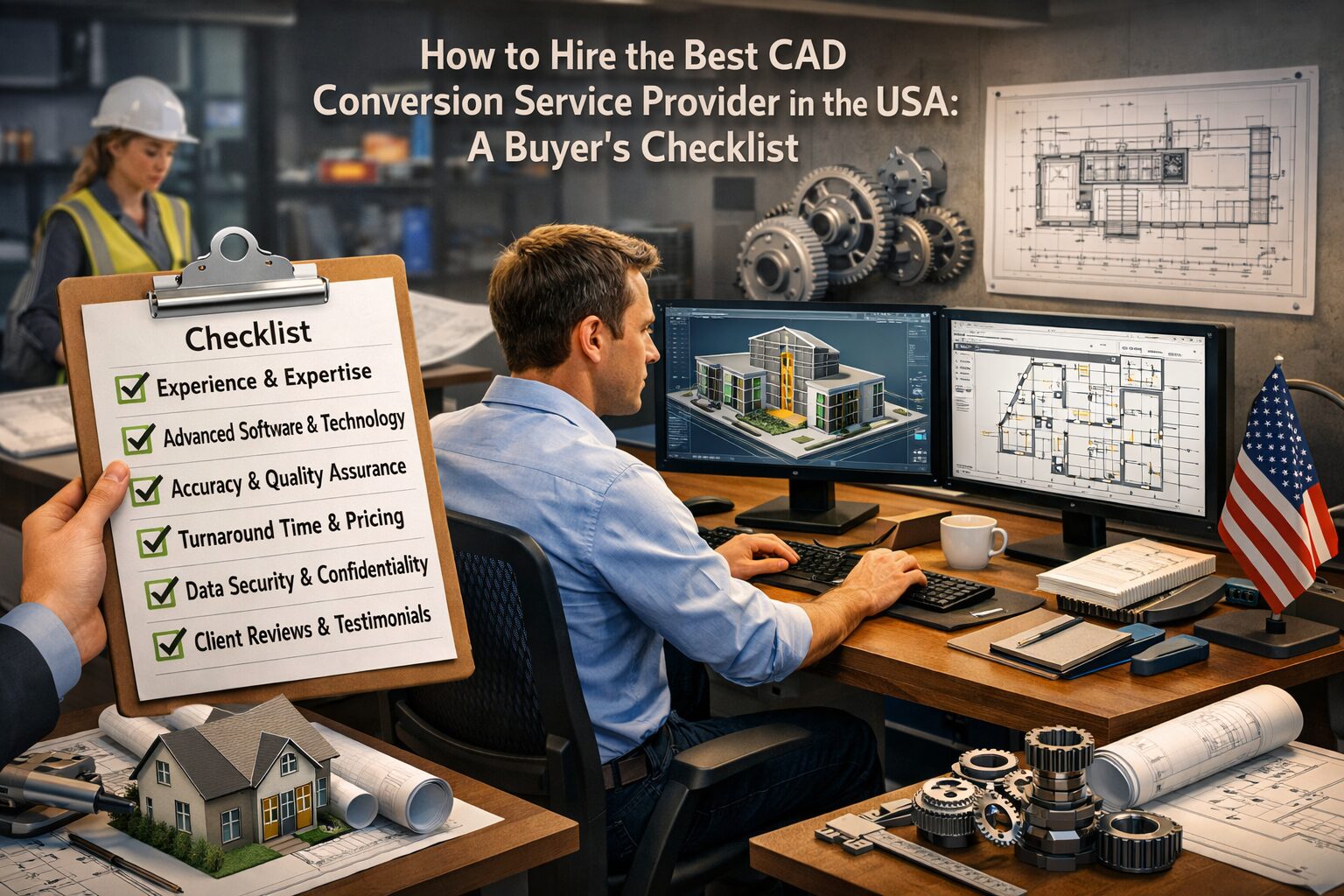
Picture this: you’re an architect in Manchester or a startup engineer in Chicago, and you’ve just inherited a box of ageing blueprints, scanned PDFs, or legacy paper drawings. You need them in a clean, editable digital format yesterday. The obvious move? Outsource to a specialist. But with hundreds of vendors claiming to offer the best-in-class CAD conversion services in the USA, how do you know who to trust?
The market is booming. The global CAD and PLM software sector was valued at USD 16.55 billion in 2024 and is set to hit USD 30.36 billion by 2032. North America already commands a 31.9% global share. The demand for digitised, interoperable design assets has never been greater and neither has the risk of choosing the wrong conversion partner.
This checklist is designed for business owners, architects, engineers, startups, and tech decision-makers in the UK, USA, and globally. It’s a no-fluff, practical guide to vetting CAD conversion vendors before you sign anything.
Why Is CAD Conversion Such a Big Deal Right Now?
The AEC (Architecture, Engineering & Construction) sector is in the middle of a sweeping digital transformation. Older firms are sitting on decades of paper drawings and raster-based scans that simply don’t integrate with modern BIM workflows, cloud platforms, or fabrication tools.
At the same time, the global 3D CAD software market is projected to grow from USD 13.2 billion in 2025 to USD 20.5 billion by 2034. Cloud-based collaboration, AI-assisted design, and 3D printing are pushing engineers to work with clean, parametric CAD files not scanned images or hand-drafted sketches.
The result? An urgent need for accurate, scalable, and format-agnostic 2D CAD conversion services and 3D migration. And that’s creating a fast-growing market for outsourced conversion specialists.
What Does a CAD Conversion Service Actually Cover?
Before you evaluate providers, it helps to understand the full scope of services that fall under the ‘CAD conversion’ umbrella:
- Paper/PDF to CAD: Converting hand-drawn or scanned drawings into editable .DWG or .DXF files.
- 2D to 3D Conversion: Elevating flat technical drawings into fully parametric 3D models.
- 2D CAD Conversion Services: Redrawing legacy 2D plans in modern CAD platforms (AutoCAD, MicroStation, etc.).
- Raster to Vector Conversion: Turning low-resolution image files into clean vector line drawings.
- Format Migration: Translating files between platforms e.g., DWG to Revit, SolidWorks to STEP, DXF to IFC.
- As-Built Drawings: Creating accurate digital records from site surveys or existing physical structures.
- BIM Conversion: Migrating CAD assets into Building Information Modelling environments.
The Buyer’s Checklist: 8 Things to Verify Before You Hire
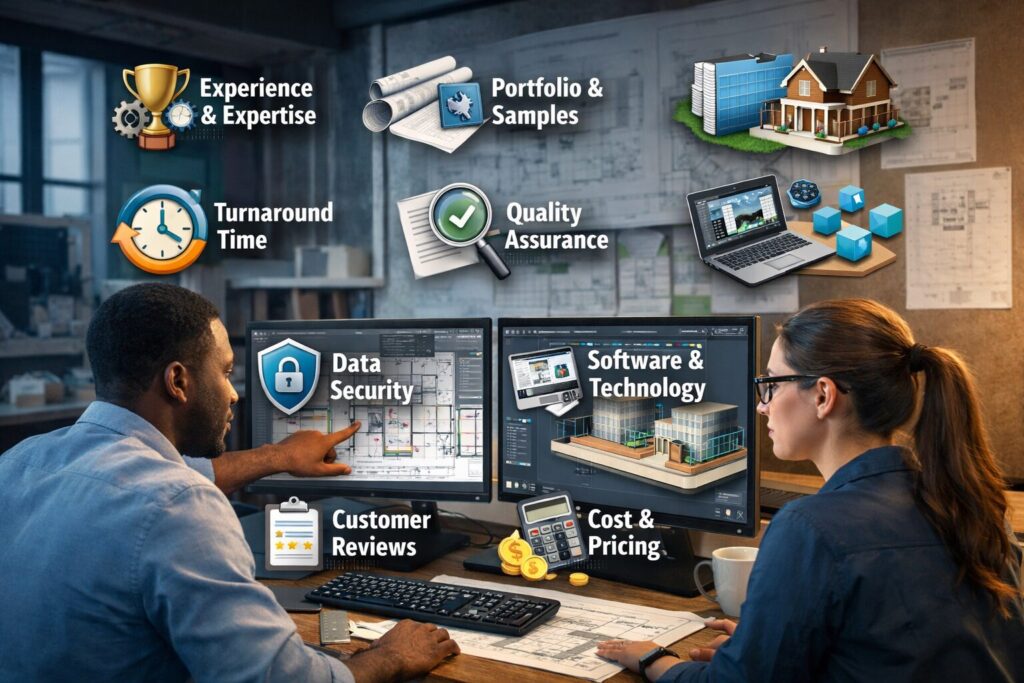
Use this checklist as your starting point every time you evaluate a new vendor whether you’re in New York, London, or anywhere in between.
1. Do They Have Verifiable Industry Experience?
Experience isn’t just tenure, it’s sector depth. A firm that converts mechanical engineering drawings will approach an architectural as-built project very differently. Always ask for:
- A portfolio of completed projects in your specific sector (AEC, manufacturing, MEP, civil, etc.)
- Case studies with measurable outcomes (e.g., reduced revision cycles, faster BIM onboarding)
- Testimonials from clients in the USA or UK markets with strict drawing standards
2. What Software and Standards Do They Work With?
The best CAD conversion service provider won’t be locked into a single platform. They should be fluent across industry-standard tools:
- AutoCAD (DWG/DXF)
- Revit for BIM workflows
- SolidWorks, CATIA, or PTC Creo for mechanical/product design
- MicroStation for civil/infrastructure projects
- BricsCAD or DraftSight for cost-effective workflows
Also confirm adherence to standards: AIA (USA), BS 1192 (UK), ISO 13567, or NCS depending on your project region. An accurate CAD conversion service will always document which standards govern their output.
3. How Do They Guarantee Accuracy?
This is the most critical question. Inaccurate CAD output doesn’t just cause rework it can delay permits, trigger compliance issues, or cause costly errors on-site. A reputable provider should offer:
- Multi-stage quality assurance (drafter > senior reviewer > QA sign-off)
- Tolerance specifications stated upfront (e.g., ±1mm or 99.5% accuracy SLA)
- A free revision policy for errors attributable to their team
- Comparison overlays or redline markups for client review
4. What Are Their Turnaround Times and Scalability?
Time pressure is real in construction and manufacturing projects. Ask whether the provider can handle volume spikes. A firm that’s great for 10 drawings but collapses under 500 is not a sustainable partner. Expect clear SLAs for standard turnaround (typically 24–72 hours for routine conversions) and rush services. Also confirm time-zone coverage if you’re UK-based and working with a USA or offshore team.
5. Is Their Data Security Up to Standard?
CAD files often contain proprietary designs, confidential site layouts, and sensitive engineering IP. Data security is non-negotiable. Verify the following:
- Non-disclosure agreements (NDAs) signed before project kickoff
- ISO 27001 certification or equivalent information security management
- Encrypted file transfer protocols (SFTP, secure cloud portals)
- GDPR compliance for UK/EU clients; SOC 2 for US-based engagements
6. Do They Offer a Transparent Pricing Model?
CAD conversion pricing can vary wildly. Per-drawing, per-hour, and project-based models all exist. Watch out for vendors who give you a lowball estimate and then add charges for layers, clean-up, or format exports. A trustworthy best CAD conversion service provider will offer a detailed quote breakdown with no hidden fees and ideally a free sample conversion on 1–2 pages before you commit to a full project.
7. What Does Their Communication and Project Management Look Like?
Poor communication kills projects. When assessing vendors, evaluate:
- Dedicated project manager or single point of contact
- Communication channels: email, Slack, project portal, video calls
- Progress reporting cadence — do they proactively update you?
- How they handle scope changes or ambiguous source drawings
8. Can They Scale With Your Future Needs?
Think beyond the immediate project. The global data conversion services market which includes CAD conversion as a core segment stood at USD 86.14 billion in 2025 and is on a steep growth curve. The firms winning in this space offer adjacent capabilities like BIM coordination, 3D visualisation, point cloud processing, and even AI-assisted drawing interpretation. Choose a vendor who can grow with your pipeline.
What Are the Biggest Red Flags When Choosing a CAD Conversion Partner?
Avoid vendors who display any of these warning signs:
- No sample work available — legitimate firms are proud of their output
- Unwillingness to sign an NDA before viewing your files
- Vague accuracy guarantees (‘high quality’ without metrics)
- Single-platform dependency (e.g., AutoCAD only, no Revit or BIM capability)
- No verifiable client references in your region or sector
- Suspiciously low pricing — accuracy and speed both cost real resources
What Trends Should You Know About in the CAD Conversion Industry?
The industry isn’t standing still. Here’s what’s shaping the landscape for buyers of CAD conversion services in the USA and UK right now:
- AI-Assisted Conversion: Machine learning models are now being used to auto-trace raster images and classify drawing elements. This speeds up turnaround and lowers costs — but human QA remains essential for precision work.
- Cloud-Based Delivery: With cloud-native CAD platforms (like Autodesk’s AEC Collection and Solid Edge X) gaining traction, conversion providers are delivering outputs directly into cloud environments with no file emailing required.
- BIM Mandate Pressure: The UK government’s BIM Level 2 mandate and similar frameworks in the USA are accelerating demand for legacy-to-BIM conversion. This is a specific niche within 2D CAD conversion services that requires specialist capability.
- Sustainability & Digital Twins: Green building certifications and digital twin requirements mean that converted CAD assets increasingly need to carry metadata and data intelligence — not just geometry.
- Offshore + Onshore Hybrid Models: Many best CAD conversion service providers now use an onshore project management layer (UK or US-based) with offshore technical delivery teams for cost efficiency without communication friction.
What Questions Should You Ask Before Signing a Contract?
These are the ten questions that separate confident buyers from those who end up with unusable files:
- What is your stated accuracy threshold, and how is it measured?
- Which drawing standards do you follow for UK and USA outputs?
- Can I see a sample conversion from my specific drawing type?
- What happens if the delivered files contain errors?
- How do you handle ambiguous or low-quality source drawings?
- What file formats are included in the quoted price?
- Who will own the CAD files upon delivery?
- How do you protect my intellectual property?
- What is your average turnaround time for [X] number of sheets?
- Do you have capacity to handle ongoing or repeat project volumes?
Is There a Difference Between Hiring in the USA Versus the UK?
Yes — and it matters. Standards, drawing conventions, and regulatory contexts differ between markets. US projects typically follow ANSI/ASME or AIA standards, while UK projects adhere to BS 8541, BS 1192, or the newer ISO 19650 BIM framework. A vendor claiming to offer CAD conversion services in the USA should explicitly confirm which standards they follow and the same applies for UK-based project delivery.
If you’re a UK business outsourcing to a US-based provider (or vice versa), request a standards alignment document as part of your onboarding. Mismatched annotation styles, title block layouts, or dimension units (imperial vs metric) can create significant downstream problems.
How Fast Is the CAD Conversion Market Growing?
Understanding market momentum helps you make smarter sourcing decisions. Here’s a snapshot:
- USD 12.2 billion— Current global CAD market size in 2025, growing to USD 22.7 billion by 2035 (CAGR 6.4%)
- 31.9% market share— North America’s share of the global CAD and PLM market in 2024
- USD 1.2 billion → USD 2.5 billion— CAD Data Exchange Software market trajectory from 2024 to 2033 (CAGR 9.1%)
- 74.3% market share— Held by the 3D design segment in 2025, reflecting the shift from legacy 2D workflows
Final Thoughts:
Choosing the right CAD conversion partner isn’t just a procurement task, it’s an investment in the quality and integrity of every project that relies on those drawings. The most common mistake buyers make is prioritising price over accuracy, only to face costly re-conversions down the line.
Use this checklist systematically. Ask for samples. Read the SLA carefully. And choose a provider whose expertise maps directly to your sector, your standards, and your scale.
If you’re a business based in the UK or working on UK/US cross-market projects and searching for a reliable, experienced team, consider consulting with a reputable UK-based CAD design company that also delivers proven CAD conversion services in the USA and internationally one with demonstrable accuracy standards, sector-specific portfolios, and the security credentials your IP deserves.
The right partner doesn’t just convert your drawings. They preserve the integrity of your design intent and that’s worth every moment spent on due diligence.
FAQs
What are CAD conversion services and why do businesses in the USA need them?
CAD conversion services transform non-editable files scanned drawings, PDFs, or paper blueprints into accurate, editable CAD formats like DWG or DXF. US businesses in architecture, engineering, and construction need them to integrate legacy designs into modern BIM workflows, cloud platforms, and digital fabrication processes.
How do I choose the best CAD conversion service provider in the USA?
To hire the best CAD conversion service provider in the USA, verify their sector experience, software proficiency (AutoCAD, Revit, SolidWorks), accuracy guarantees, data security certifications, and turnaround SLAs. Always request a free sample conversion and check for NDA policies before sharing any proprietary drawings.
What is the difference between 2D CAD conversion and 3D CAD conversion?
2D CAD conversion services re-draft legacy or scanned flat drawings into editable vector formats within platforms like AutoCAD. 3D CAD conversion goes further; it rebuilds geometry into fully parametric solid models using tools like SolidWorks or Revit, enabling simulation, fabrication, and BIM integration that flat 2D files cannot support.
How much do CAD conversion services cost in the USA?
CAD conversion costs in the USA typically range from $5 to $50 per sheet for standard 2D drawing conversion, depending on complexity, turnaround speed, and volume. 3D conversion and BIM migration projects are usually quoted on a project basis. Always request a detailed line-item quote to avoid hidden fees for layers, formats, or revisions.
How long does CAD conversion typically take for large drawing sets?
Standard 2D CAD conversion of individual drawings can be completed in 24–72 hours. Large drawing sets of 50–500+ sheets typically require 5–15 business days, depending on complexity and provider capacity. Rush services are available from most reputable firms, though they carry a premium. Always confirm turnaround SLAs in writing.
Are CAD conversion services in the USA suitable for UK-based businesses?
Yes many UK architects, engineers, and construction firms successfully outsource to CAD conversion services in the USA, particularly for large-volume or specialised projects. Key considerations include confirming standard compliance (BS 1192, ISO 19650 for UK; AIA/ANSI for USA), GDPR data handling, and time-zone communication coverage before contracting.
What questions should I ask a CAD conversion company before hiring them?
Before hiring, ask about accuracy thresholds and revision policies, drawing standards followed (ANSI, BS, ISO), data security certifications (ISO 27001, GDPR), software platforms used, turnaround times, and pricing structure. Also request a sample conversion from your drawing type and confirm IP ownership upon delivery.