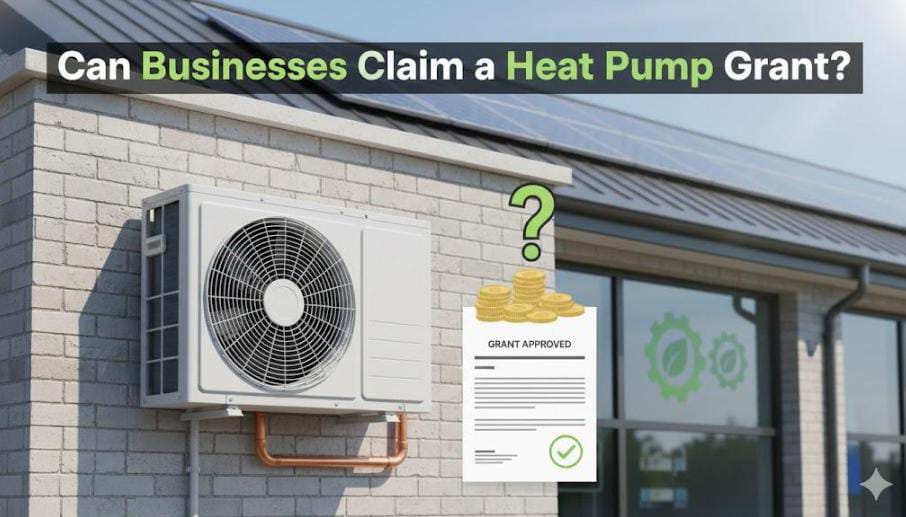
Can Businesses Claim a Heat Pump Grant?
Last Updated on January 13, 2026 by Usama
Yes. Businesses can claim an air source heat pump grant in 2026. But here’s what nobody tells you upfront: eligibility isn’t about your turnover or employee headcount. It’s about your property size and who owns it.
We have compiled this guide to help UK businesses get subsidised heat pumps for their small to mid-sized properties.
The Boiler Upgrade Scheme: Your £7,500 Ticket
The government’s Boiler Upgrade Scheme (BUS) is the primary grant available to businesses. Not just homeowners, but businesses too. You get £7,500 for air-source or ground-source heat pumps. That’s a direct discount applied at installation. No complicated reimbursement process. No waiting months for a cheque.
The catch? Your heating system can’t exceed 45 kilowatts thermal capacity. Most small offices, retail units, and hospitality venues fall comfortably under this threshold. Think you’re too big? Maybe. But don’t assume, get your installer to calculate your actual heating load first.
Here’s the breakdown of what you can claim:
| System Type | Grant Amount |
| Air-source heat pump | £7,500 |
| Ground-source heat pump | £7,500 |
| Air-to-air heat pump | £2,500 |
| Biomass boiler | £5,000 |
The scheme runs until March 2028. That gives you time, but not forever. Budget allocations get reviewed quarterly. Wait too long? You might find yourself competing for limited vouchers.
Who Actually Qualifies? (It’s Simpler Than You Think)
Forget the bureaucratic jargon for a moment. BUS eligibility boils down to three things: property ownership, location, and your current heating system.
Do You Own the Building?
Simple question. Do you own it? Then you qualify. Leasing the building but owning nothing? You’re out. The business must have legal ownership of the property or at least the building where the system is installed.
Sale-and-leaseback arrangements work. So do properties you’re actively purchasing. The key is ownership at application time.
Got multiple locations? You can apply separately for each distinct property. Franchise operators, pay attention, this means grants for every site you own.
Is Your Property in England or Wales?
England and Wales only. Scotland has Home Energy Scotland. Northern Ireland has separate schemes. Don’t waste time applying if you’re outside these regions.
Social housing properties don’t qualify. New builds are excluded too, with limited exceptions for self-builds.
What’s Your Current Heating System?
Here’s where it gets specific. You must be replacing a fossil fuel system: gas, oil, LPG, coal, or electric storage heaters. Already have a heat pump? You can’t get BUS funding to upgrade it. The grant exists to eliminate fossil fuel heating, not to give you a newer low-carbon system.
Already claimed government heating grants before? ECO4? Renewable Heat Incentive? You’re disqualified. One grant per property. That’s the rule.
The EPC Requirement (And Why It Matters Less Now)
You need an Energy Performance Certificate issued within the last 10 years. That’s mandatory. But here’s the good news: since May 2024, you don’t need a “clean” EPC anymore. Used to be that any insulation recommendations would block your application. Not anymore.
Just have an EPC. That’s it.
Most commercial properties already have one from lease agreements or sales. Don’t have one? Order it now. It takes two weeks, costs around £100, and you’ll need it anyway.
How the Application Actually Works
Forget government forms. BUS is installer-led. You don’t fill out paperwork—your installer does.
The process:
- Get quotes from MCS-certified installers
- Choose one
- They submit the application to Ofgem
- Ofgem contacts you to confirm identity and permission
- Approval comes through
- Installation happens within 120 days (180 for ground-source)
- Grant gets deducted from your final bill
The installer vouchers must be submitted within 120 days of system commissioning. Miss that window? Your grant application dies.
One critical detail: the £7,500 comes off your invoice before you pay. You’re not waiting for reimbursement. Your installer claims it directly from Ofgem after completing the work.
What If You’re Too Big for BUS?
So your heating system exceeds 45 kWth. Now what? You’re not completely out of options—they’re just less straightforward.
Regional utility rebates exist but vary wildly by location. Some utility providers offer incentives for commercial heat pumps based on capacity or energy savings. You’ll need to research what’s available in your area.
Capital allowances under corporation tax rules can offset installation costs. The specifics depend on your business structure and how the system gets classified. Talk to your accountant before committing to a six-figure heat pump installation.
Green financing options from specialised lenders offer preferential terms for energy-efficient upgrades. Spreading costs over time might make more sense than draining capital reserves upfront.
ECO4 ends in March 2026. The replacement Warm Homes Plan is still being finalized. If you’re banking on successor schemes, you’re gambling on policy details that don’t exist yet.
The Numbers Nobody Talks About
Let’s talk running costs. Heat pumps typically cost 3 to 4 times less to operate than fossil fuel boilers—when electricity and gas prices are comparable. That’s not marketing fluff. That’s thermodynamic efficiency.
But here’s the kicker: zero VAT on heat pump installations through March 2027. That’s an additional 20% saving on labour and materials. Combined with the £7,500 grant? You’re looking at meaningful cost reduction before you even factor in long-term operational savings.
Want to know what that looks like in practice? A typical small business spending £3,000 annually on gas heating could drop to £750-£1,000 with a properly sized heat pump. Over five years, that’s £10,000 to £11,250 in savings—on top of the upfront grant.
Compliance and Documentation (Don’t Cut Corners)
Your installer will verify that your previous heating system was fossil fuel-based. They’ll want utility bills, previous EPCs, or photos of your existing boiler. Ofgem runs routine compliance checks and audits. Provide false information? You’ll face disqualification and potential fraud investigations.
This isn’t a system you can game. Documentation must be accurate. Property ownership must be legitimate. Previous funding claims must be disclosed.
Mess this up and you’re not just losing the grant—you’re potentially facing legal consequences.
Should You Apply Now or Wait?
The scheme runs until 2028. You have time. But here’s what you should consider: budget quarters matter. Tight quarters mean faster processing or increased competition for vouchers. There’s no advantage to waiting if you’re planning to replace your heating system anyway.
The decision framework is straightforward:
- Heating system due for replacement in the next 24 months? Apply now.
- System still functional but aging? Get quotes and plan for 2026-2027.
- New installation with years of life left? Wait, but monitor budget updates.
One final point: don’t let the £7,500 grant be the only reason you install a heat pump. The operational savings, zero VAT relief, and reduced carbon footprint should collectively justify the investment. If the grant is the only thing making the numbers work? Your business case is too fragile.
Bottom Line
Small to medium businesses can access substantial heat pump grants in 2026. The 45 kWth capacity limit matters more than business size. Property ownership is non-negotiable. The installer-led process is simpler than most government schemes, often including a site assessment to ensure the unit meets local planning requirements and manages Heat Pump Noise levels effectively. And if you’re planning to replace aging fossil fuel heating anyway, you’d be foolish not to claim the £7,500 sitting on the table.
The scheme exists. The money is allocated. The question isn’t whether you can access it—it’s whether you’re organised enough to actually claim it.