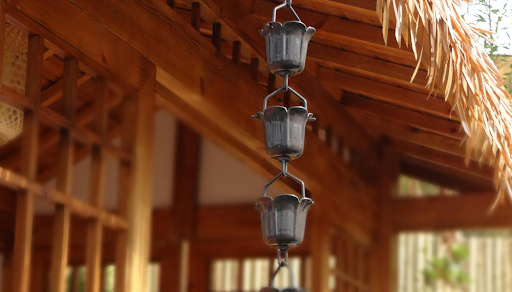
A blockage after autumn, a crack during a cold snap, an unsightly stain running down the wall… What if there were a way to handle rainwater drainage that actually added character to a building instead of hiding behind it? That is exactly the idea behind rain chains for gutters, a concept rooted in Japanese tradition that a small French company has been bringing to European homes for over a decade.
The company in question is Rain Chains Europe !
Rain Chains Europe: who is this French company?
Everything started with a trip. In 2009, Bertrand Le Mellat travelled to Japan and came across kusari doi for the first time ; these elegant metal chains hang from the eaves of traditional houses and temples, guiding rainwater from the rooftop down to the ground in a gentle, visible cascade. He was struck by how something so simple could turn a practical necessity into a genuinely beautiful feature. Three years later, in 2012, he launched rain chains for gutters from the city of Le Mans, in western France.
The early years were spent understanding just how varied European guttering systems are. Outlet sizes differ from one country to the next, climates range from mild Atlantic conditions to harsh Scandinavian winters and architectural styles span centuries. Bertrand and his team worked through each of these challenges, selecting materials robust enough for any region and developing fittings compatible with the most common gutter configurations found in the UK, France, Germany, Spain and beyond.
Today the catalogue includes more than a hundred designs, split across several categories: cup chains, large cup chains, link and loop chains, artistic creations, water basins and accessories… Every product is handcrafted and the company backs each one with a ten-year warranty and a sixty-day trial period.
Moreover : a showroom exists, sits at Le Mans, but most sales happen online. Orders ship within three to seven working days across Europe and the team is reachable by phone or email for personalised recommendations !
Rain chains for gutters: let’s discover this new tendency!
Rain chains. The concept itself is straightforward ; instead of routing rainwater through a closed plastic or metal pipe, you let it travel along an open chain or series of cups fixed vertically beneath the gutter outlet. Gravity does the work. The water moves from link to link until it reaches a basin, a barrel or simply the ground below.
The first benefit is visual. During a shower, the chain transforms into a living water feature. Light catches the droplets, the sound is soft and rhythmic and the effect is remarkably calming. Plenty of homeowners describe it as a zen moment in the middle of an otherwise grey afternoon. But the practical advantages go further than aesthetics !
Traditional downpipes are enclosed, which means debris collects inside where you cannot see it ; leaves, moss, even bird nests can block the flow and cause water to back up into the gutter. That overflow eventually damages fascia boards and exterior walls. Rain chains sidestep the issue entirely. Nothing accumulates because nothing is hidden.
Frost resistance is another strong point. When water freezes inside a sealed pipe, the expanding ice can crack the material. Open chains allow ice to form without building pressure, so they handle cold winters far better than rigid tubes. Given how unpredictable European weather can be, that durability is a genuine selling point.
Directing the flow into a collection vessel is effortless with a chain: you simply place a barrel or basin underneath. No adapters, no plumbing. In a period when water conservation matters more than ever, that simplicity counts for a lot.
Copper, stainless steel or aluminium: choosing the right material for your home
One question comes up regularly when people consider switching to rain chains for gutters: which metal should I go for? The answer depends on the building, the budget and personal taste :
- Copper : it starts with a bright, warm tone and gradually develops a greenish patina as it weathers. That aged look pairs exceptionally well with stone facades, Victorian terraces and rural properties. Copper is also extremely durable; it resists corrosion naturally and can last for decades without any treatment ;
- Stainless steel : it appeals to people who prefer consistency. It keeps its polished finish year after year, with no colour change and minimal upkeep. On contemporary facades, glass extensions or minimalist garden designs, a gleaming stainless chain creates a clean, modern accent. It is also incredibly strong ;
- Aluminium : lighter and more affordable than copper or steel, it comes in various finishes and colours. Over time, aluminium may lose a little surface brightness, but it remains structurally sound.
Beyond the material itself, the shape of the chain matters. Cup designs handle heavier rainfall with less splash. Link and loop styles produce a more dramatic visual effect but may let a few droplets escape during intense downpours. For large roof areas or regions with frequent heavy rain, wider cups are generally recommended. For sheltered spots or smaller roofs, links and loops bring an elegant, almost sculptural quality to the facade.
Installation is another point where rain chains for gutters score highly. The whole process takes about 15 minutes and requires no specialist equipment. You pull the old downpipe out of the gutter outlet, hook the chain into place using the supplied fitting and anchor the base. That is the entire job. Hooks are the same for a 60 mm to a 150 mm gutter and reducers are available on standard size, permitting to reduce depending on the diameter of the chain .
Also, pairing a rain chain with a water basin at its base turns the setup into a complete harvesting system. The basin catches every drop and you can connect it to a garden hose or watering can whenever you need it. During dry spells, that stored water becomes genuinely valuable for flowerbeds and vegetable patches.Rain Chains Europe has spent over a decade proving that guttering does not have to be boring. Their handcrafted chains turn a forgotten corner of the house into something people actually notice and enjoy. With a wide catalogue, solid warranties and delivery across the continent, they have made the transition from pipe to chain as painless as possible. If you have never considered changing your downpipes, it might be time to look up.