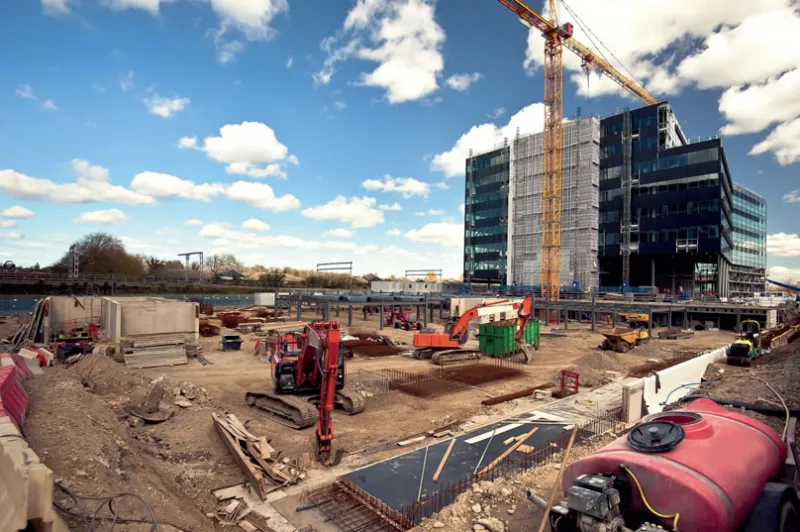
Most site safety talks focus on big hazards. You’ll hear about height, heavy loads, and deep excavations. Those matter, obviously. But the issues that actually cause the most day-to-day incidents are usually tied to coordination.
How is your equipment being managed? An air compressor can become a big hazard if it’s not stored correctly. It could be blocking walkways. Workers might have to tiptoe around pressure hoses all day. And those problems are going to cost you more than just time. Unmanaged equipment is very dangerous to everyone on the site.
When site flow works, safety follows.
If you watch a well-run site, the first thing you notice is spacing. People aren’t crowding each other. Machines aren’t crossing paths unnecessarily. Materials arrive where they’re needed without being dragged across active zones.
Good flow is one of the strongest safety measures you can have, and it doesn’t cost anything extra. It just requires planning how work moves before work starts. When tasks are sequenced properly, crews don’t overlap in dangerous ways. When routes are clear, nobody has to improvise shortcuts.
Most close calls happen when movement patterns clash. Two teams try to use the same space. Equipment enters an area intended to remain clear. Work speeds up, but coordination doesn’t.
Rushing creates more risk than weight.
Heavy machinery gets blamed for safety problems because it’s visible. But rushing your work is far more dangerous than weight. When schedules tighten, people start compressing steps. They skip checks. They multitask. They move faster than conditions allow.
Picture finishing a job late in the afternoon when everyone wants to wrap up. Instead of waiting for a clear path, someone moves equipment through a partially cleared zone. Nothing happens that time. So the next day, it feels safe to do it again. That’s how unsafe habits form: repetition without consequence.
You can’t blame rushing on pressure. Construction always has pressure. That’s expected. The issue is when speed replaces sequencing. Work should accelerate only when the environment supports it. Otherwise, you’re trading minutes now for problems later.
Communication gaps cause more incidents than equipment.
One of the most common safety failures is an information problem. People simply don’t know what someone else is about to do.
Sites are loud. Instructions get shouted. Plans change mid-shift. A crew thinks an area is clear while another team assumes it’s active. That mismatch is where accidents usually start.
Clear signalling systems fix more problems than new machines ever will. Radios, visual markers, and agreed movement calls. These are simple systems that prevent confusion. Without them, workers rely on guesswork. And guesswork has no place around machinery.
Movement zones matter more than machine size.
There’s a tendency to focus on safety rules for large equipment while ignoring those for mid-sized operational machines. But size isn’t what determines risk. Interaction does.
A forklift, for example, is fine on its own. But it becomes dangerous when pedestrian routes overlap with its path or when loading zones aren’t clearly defined. The machine is predictable. Human movement isn’t. That’s why layout design matters so much.
Safety improves dramatically when machines use dedicated routes rather than shared ones.
Training is all about awareness.
People sometimes think safety training is about the safety manuals and the protocols you’ve been trained on once. And while that is very important, it’s not all there is to procedures. Real safety training is about learning how to read an environment.
Things will change around you as you move from one site to the next. The safest route is to know how safety procedures change around each new place you work.
A lot of this awareness actually comes from experience. You see a machine fail, and next time, you’re able to predict it before it happens. That’s real safety training: adaptive and very effective.
Real training builds that awareness. And once someone has it, they carry it everywhere.
The ground itself can be the risk.
Not all safety hazards move. Some sit under your feet. Ground conditions affect everything on site, from footings to machine stability. Uneven or poorly compacted surfaces increase slip risk, shift loads, and affect equipment handling.
That’s why surface preparation is more than a finishing step. Machines like a road roller stabilize the ground so everything above it behaves predictably. When the base layer is solid, equipment moves properly and everything stays balanced, quite literally.
People often assume safety comes from strict rules or expensive systems. In practice, it usually comes from something simpler: clarity. Clear routes. Clear signals. Clear sequencing. Clear responsibilities.
When everyone knows what’s happening and where it’s happening, risk drops fast. No surprises. No doubts. Just confidence and a smooth operation.